

For a lot of homeowners, the words “planning permission” are enough to put the brakes on a project before it’s even started. The process can feel opaque, slow, and uncertain — and nobody wants to spend money on architect fees only to be told no.
Here’s the good news: many of the most common home improvement projects in the UK don’t actually need planning permission at all. They fall under something called Permitted Development rights — a set of government-granted permissions that allow certain types of work to proceed without a formal planning application.
Understanding what falls under Permitted Development, and what doesn’t, can save you weeks of waiting, significant costs, and a lot of unnecessary stress. This guide will walk you through everything you need to know.
What Is Permitted Development?
Permitted Development (PD) rights are automatic planning permissions granted by the government — not by your local council. They set out the types of works that homeowners can carry out without needing to submit a planning application, provided certain conditions and limitations are met.
The rules are set out in the Town and Country Planning (General Permitted Development) (England) Order 2015 (as amended), and they’ve been updated several times in recent years to make it easier to extend homes — particularly under the Larger Home Extension scheme.
Think of PD rights as a framework: they give you permission to do certain things within defined parameters. Go beyond those parameters, and you’ll need to apply for full planning permission in the usual way.
Important: PD Rights Aren’t Universal
Not every home has Permitted Development rights. Properties in Conservation Areas, Areas of Outstanding Natural Beauty (AONBs), National Parks, and World Heritage Sites have restricted PD rights. Listed buildings have almost none. Always check with your local planning authority or an architect before assuming PD applies to you.
What Can You Do Under Permitted Development?
The short answer is: quite a lot. Here are the most common types of work that fall under PD rights for residential properties in England.
Rear Extensions
Single-storey rear extensions up to 4 metres deep for detached houses, or 3 metres for all other house types, under standard PD rights. Under the Larger Home Extension scheme, these limits increase to 8 metres (detached) and 6 metres (other) — subject to a neighbour consultation process.
The extension cannot exceed 4 metres in height for a single-storey structure, and the eaves height must not exceed 3 metres if within 2 metres of a boundary.
Loft Conversions
You can add up to 40 cubic metres of additional roof space for terraced houses, or 50 cubic metres for detached and semi-detached homes. Dormer windows to the rear are permitted; additions to the principal (front) elevation generally are not.
Outbuildings & Garden Structures
Sheds, home offices, garages, and other outbuildings are permitted up to a maximum height of 2.5 metres if within 2 metres of a boundary (or 4 metres for a dual-pitched roof elsewhere). The outbuilding cannot cover more than 50% of the land surrounding the original house.
Porches
A porch can be added to any external door, provided the ground area doesn’t exceed 3m², the height doesn’t exceed 3 metres, and it’s not within 2 metres of a highway boundary.
Internal Works
Most internal alterations — removing walls, reconfiguring layouts — don’t require planning permission at all, though some structural changes will need Building Regulations approval.
What Permitted Development Doesn’t Cover
It’s equally important to understand what falls outside PD rights. In each of these cases, you’ll need to submit a full planning application:
- Side extensions (unless very modest in scale and meeting specific criteria)
- Double-storey rear extensions in many circumstances
- Any extension that would result in more than 50% of your garden being covered by buildings
- Changes to the roof on the front elevation that are visible from a public road
- Works on listed buildings (which require Listed Building Consent)
- Works in Conservation Areas that affect the exterior appearance of the property
- Anything that would materially alter the external appearance of a flat or maisonette
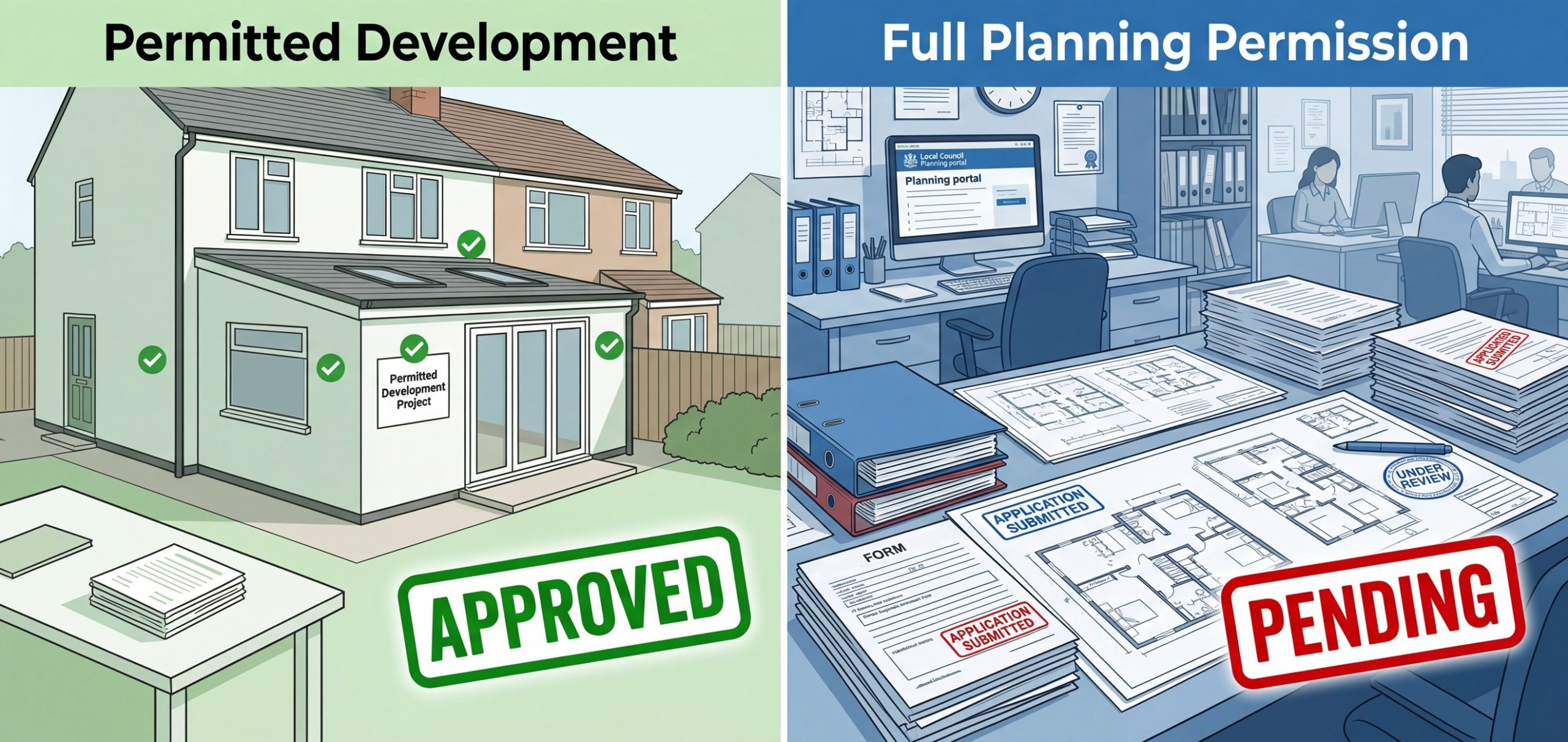
Permitted Development vs Full Planning Permission
| Permitted Development | Full Planning Permission | |
| Application needed? | No (or Prior Approval only) | Yes |
| Typical timeframe | 0–8 weeks | 8–13 weeks (or more) |
| Design flexibility | Within set parameters | Greater flexibility |
| Neighbour objections | Limited impact | Can affect outcome |
| Cost | Lower (no application fee) | Application fees apply |
| Certainty | High (if within limits) | Subject to LPA decision |
Prior Approval and Lawful Development Certificates
Prior Approval
Some PD works — notably the Larger Home Extension scheme — require Prior Approval from your local planning authority before you begin. This is a simpler, faster process than full planning, but it does involve a neighbour consultation period of 21 days. If neighbours object, the council will assess the impact. If no objections are raised (or if they are not deemed significant), you’ll receive approval and can proceed.
Lawful Development Certificates
Even when work is clearly within PD rights, it’s strongly advisable to obtain a Lawful Development Certificate (LDC) from your local council. This is a formal confirmation that your project is lawful under PD rights, and it’s invaluable when it comes to selling your home. Without it, buyers’ solicitors may raise questions — and you may find it difficult to prove that the work was legitimate.
Your architect can prepare and submit an LDC application on your behalf. The fee is currently half the normal planning application fee, and the process typically takes 8 weeks.
Always Get an LDC — Here’s Why
A Lawful Development Certificate is proof that your extension was built within Permitted Development rights. When you come to sell your home, your solicitor will likely be asked to provide evidence that all works were lawfully undertaken. An LDC is the clearest, most defensible form of that evidence.
Recent Changes to Permitted Development Rights
PD rights have been expanded several times in recent years, and it’s worth being aware of the more significant changes:
- The Larger Home Extension scheme was made permanent in 2019, doubling the depth allowance for single-storey rear extensions (subject to Prior Approval).
- New PD rights were introduced to allow the conversion of commercial and retail buildings to residential use — relevant for mixed-use developments and investors.
- Upward extension rules were introduced in 2020 to allow additional storeys to be added to existing houses, subject to various conditions.
Rules do change, and local variations exist — so it’s always worth getting current advice from a qualified architect before assuming what applies to your property.
Where an Architect Adds Value
Navigating PD rights might sound straightforward on paper, but there are genuine complexities — and getting it wrong can be costly.
An architect will assess your specific site and property, confirm what falls within PD rights, advise on whether Prior Approval or an LDC is needed, design your project to make the most of what’s permitted, and manage the process from start to finish. More importantly, a good architect will look at the bigger picture: is the best outcome for your home necessarily the one that fits neatly within PD limits? Sometimes the right answer is to apply for planning permission and unlock a more ambitious design.
We understand that navigating planning rules is not most people’s idea of a good time. Part of our job is to make that process as painless as possible — handling applications, liaising with planning officers, and keeping you informed throughout. If you’re wondering whether your project qualifies for Permitted Development, the best place to start is a conversation.
Not Sure Where You Stand?
Whether you’re confident you fall under Permitted Development or have no idea where to begin, we’re here to help. A short conversation with our team is usually enough to give you a clear picture of what’s possible and what’s involved.
Reach out via our contact page: https://blanklinearchitecture.com/contact/ — we look forward to hearing about your project.